Murder as a business
The Pale HorseMurder as a business is the principle that turns the Pale Horse network’s killings into a commercial service rather than an act of personal passion. The organization makes death appear to be a subject for prediction, a wager, and financial convenience, while distributing the work so that most participants do not know the whole plan. Its polished procedures are designed to make murder look like natural death—and to make the business difficult to trace.
From violence to transaction
The concept is stated most sharply when Ginger insists that the suspected crimes are neither hot-blooded acts of hate or jealousy nor ordinary murders for personal gain. They amount instead to murder as a business: an impersonal operation that takes no account of who the victim is. Her distinction changes the scale of the inquiry. The danger is not simply one person’s grievance, but a service that can be purchased against unwanted people.
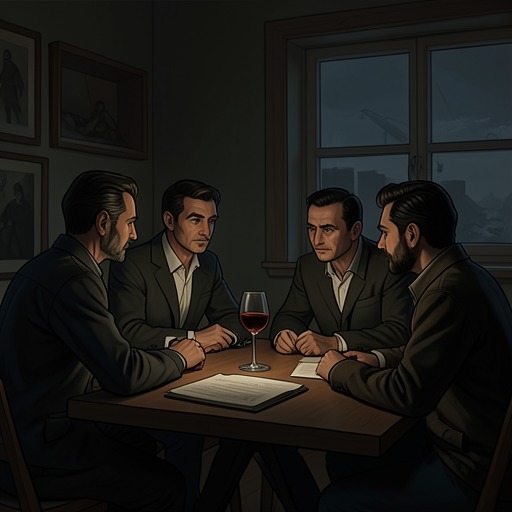
The organization’s financial intermediary, C.R. Bradley, gives the service a respectable-seeming form. A disbarred lawyer, he tells Mark Easterbrook that his recommendations are legal because the arrangement is a bet. People may wager on uncertain outcomes, he argues, and a client can bet that someone will remain alive while Bradley takes the opposing position. This language recasts a death as a forecast rather than a crime, allowing the client to avoid describing the desired outcome as a direct request for murder.
Bradley’s hypothetical example makes the financial motive explicit. A client might want to know whether a wealthy relative will die by a certain date, because an expected inheritance could affect a business decision. The client need not openly wish the relative dead; the wager is presented as a way to manage uncertainty. In practice, however, the bet gives the killing a price and a timetable. Bradley says the terms depend on the amount at stake and, in some cases, the client’s available funds; the usual odds are five hundred to one. He distinguishes clients who can afford substantial fees from poorer clients, while allowing an estate’s value to shape an arrangement involving an expected inheritance.
When Mark presses him, Bradley proposes odds of fifteen hundred to one that the woman in question will die before Christmas. Mark insists that she would have to die sooner, emphasizing urgency to sustain his role as a prospective client. The exchange shows how the organization’s business idiom accommodates both a client’s means and the demanded timing. The wager is not a harmless abstraction: its terms are the commercial face of a killing arranged elsewhere.
A divided organization
Inspector Lejeune’s account describes an agency specializing in the removal of unwanted people, using methods that leave no obvious sign of violence. Several deaths under investigation appear to have resulted from natural causes, and there are indications that people profited from them, but Lejeune stresses that the evidence remains incomplete. The organization’s sophistication lies partly in the gap between the deaths and the people who benefit from them: a pattern is suspected, but proof is difficult to assemble.
The network separates its functions. C.R. Bradley handles the financial and legal side; Mark understands him to be paid handsomely, while Thyrza Grey is also paid for her role at the Pale Horse. Thyrza is the operation’s visible presiding figure there, but Mark says that the real organizer works behind the scenes, planning and coordinating. Bradley, by contrast, does not know what happens elsewhere. Each participant has a job, and the carefully arranged division means that no one is supposed to possess the entire account of the crime.
The client’s route through the scheme further separates its stages. Prospective clients visit Bradley’s office in Birmingham to make the bet, then visit the Pale Horse, where Thyrza and her associates stage an experience intended to impress them. The financial agreement and the ritualized display are distinct parts of one business: one makes the transaction appear to be gambling, the other reinforces the client’s belief that the organization can bring about the predicted death.
Ordinary routines as cover
The hidden practical method depends on information gathered through apparently routine consumer research. Women employed by legitimate research concerns are assigned to canvass a neighborhood with questionnaires about familiar household products, including bread, cosmetics, medicines, and remedies. The questions establish which ordinary products a particular person uses. Because people are accustomed to answering surveys, the collection of this information can pass without attracting much suspicion.
A separate operative then uses a plausible everyday role to reach the home. The person might appear to be a porter, a meter reader, a plumber, or an electrician, carrying credentials that seem appropriate to the visit. The stated task provides cover for replacing a product the intended victim already uses with a similar preparation. The research and the substitution are connected, but they are not necessarily performed by the same person; the information gathered by the questionnaire makes the later intrusion more targeted.
The delay is part of the concealment. For several days, nothing may happen. When illness eventually appears, a doctor has little reason to suspect a familiar household product that the patient has used for years. The organization thus exploits both trust in ordinary routines and the tendency to interpret illness through everyday causes. A visit, a questionnaire, and a commonplace preparation collectively conceal an intervention that would be harder to hide if it looked like an overt attack.
The business’s governing logic
The operation’s design joins profit to distance. Clients do not have to approach the intended victim directly; Bradley supplies a financial mechanism, and other participants undertake separate tasks. The head of the organization is the only person who knows what that organizer personally does, according to Mark’s explanation to Lejeune. Such compartmentalization limits what any one participant can disclose and helps the person at the center avoid exposure.
The system’s most disturbing feature is the contradiction between its calm procedures and their consequence. Bradley speaks in the measured manner of a professional adviser, treats the terms as negotiable, and presents the wager as ordinary business. Yet the supposed uncertainty of the bet is manufactured by a network built to cause the death on which the client has wagered. What appears to be a prediction is therefore also a concealed service contract.
The phrase murder as a business names both the organization’s method and its moral transformation of killing. Personal hatred or direct greed gives way to an impersonal chain of information, payment, access, and concealment. The victims become targets in a process whose participants may see only their assigned task. By uncovering the ordinary mechanisms beneath the Pale Horse’s theatrical display, Mark and Lejeune expose how modern-looking organization can make murder seem remote, technical, and almost routine without making it any less deliberate.